Friday, October 18, 2024

Dungeon Crawl Classics: Appendix R


From the DCC Rulebook, the Appendix R section:

The Dungeon Crawl Classics Role Playing Game plays like a 1974 game. The rule set deliberately omits many modern concepts in order to speed game play. During playtest, a variety of players suggested varying rules for further defining areas of play. These suggestions were discarded because they increased complexity and had no precedent in the 1974 rules. In other words, if it could be handled ad hoc in 1974, it can be handled ad hoc now.

That said, some judges do wish to expand the game to suit their own style. There are many well-recognized rules categories which have been deliberately omitted herein: miniatures rules, feats, skill points, prestige classes, races distinct from classes, weapon proficiencies, attacks of opportunity, and so on. These spaces are “blank” within the rules so the judge can easily add in those parts he feels are necessary.

Think of it as a map with many undefined places. The DCC RPG rules leave these blank spots deliberately undefined. Now you as the judge should fill in those regions of the map that most benefit your style of play.

It is strange to think of DCC as a "magic, combat, and class" mod for any OSR game, but according to the description in Appendix R, that is essentially what it is. It can be played alone or as the "engine" for any other old-school game, with that game's books serving as expansion guides. This section directly references the 1974 rules, which would equate nicely to three fantastic games:

Swords & Wizardry Revised.

White Box Fantasy Medieval Adventure Game.

And Iron Falcon.

These would be my "go-to" supplement games for DCC since they are all based on the 1974 rules. There is an apparent "back to basics" movement in the hobby, where the 1974 rules are embraced, and the later AD&D, B/X, and BECMI rules are seen as things that came after that original "spark of inspiration." Also, DCC is not a "1974 purist game" since it uses many 3.5E mechanics, such as the saving throw system. The 3.5E mechanics were very familiar to the DCC designers and play-testers, so they chose to embrace those.

S&W is my favorite of all of these, just because it eliminates a lot of unnecessary detail and cruft. It also feels fantastic for a lot of the classes, and it is unafraid to limit bonuses to classes that deserve them more than others.

However, DCC is open to expansion and is meant to be the base framework for a larger DIY game. You could expand this with Old School Essentials and have everything you need. OSE is also a good pick since the organization is top-notch, and the books are high quality and informative.

I like OSRIC since the game takes on a dire, simulation-style, realistic feeling. This is like mixing the game with AD&D; since AD&D is awesome, this becomes more awesome. You get the whole "battle of good and evil" thing going on, encumbrance rules, equipment lists, tons of magic items and treasures, exploration, hirelings, lots of monsters, and all the classic "feel good" AD&D bits in there that give me good memories. I would not directly use AD&D since the retro-clones are always better and support free and open communities.

All these games are worth playing by themselves! S&W and OSRIC are "best in class" games and two of my all-time favorites.

OSRIC plus DCC is the "ultimate OSR game" for me. It's DCC plus all the missing parts; you can customize many game rules from all the sections in the book. I like it better than S&W since there are many more optional rules and subsystems to plug in. Sages and hirelings get a lot of detail, along with treasures. S&W is a stripped-down 1974 purist game that reduces complexity. OSRIC goes into deeper levels of depth, giving me more to choose from and making my world more textured and realistic.

Wednesday, October 16, 2024

DCC: OSRIC as the +1 Game

OSRIC is a fantastic game. It is the best AD&D-like game out there. It was written as a reference work for the original game but with enough slight differences to be a partial copy. This started before copies of AD&D were out there to buy, and it still sits as the better version of the DTRPG print-on-demand copies that are filled with errors.

OSRIC is not just a game; it's a platform that empowers AD&D players. Its superior organization and the opportunity to contribute to the game's content provide a flexible and empowering gaming experience. This is further enhanced by a wealth of indie adventures and supplements, making it the ultimate choice for AD&D enthusiasts.

Also, you are not putting wear and tear on your collector's items.

But using OSRIC as your +1 game for Dungeon Crawl Classics is an interesting choice since the game is very detailed, has the OG vibe, and gives the experience a gritty AD&D-like feeling and hardcore atmosphere. There are a few points worth remembering in the conversion, such as DCC not using magic resistance. Also, this conversion for AC is handy:

DCC AC = 20 - ORSIC AC

The AC conversion is straightforward. For instance, an AC 6 equals a DCC AC of 20 - 6, which equals 14. Remember the 'subtracting a negative number rule' for cases like an AC of -2, which becomes a DCC AC of 20 - (-2), resulting in 22.

You could also set the "target number" for your to-hits to 20 and add the OSRIC (descending) AC (and any other attack modifiers) to the roll. Don't believe me? That OSRIC AC of 6 is a DCC AC of 14, and an attack modifier of +1 gives a 13+ on a d20, or a 40% chance to hit. The OSRIC AC of 6 with that attack modifier of +1 nets a +7 chance to strike against a target number of 20 or a 40% chance to hit.

Also, in DCC, hit dice are not always d8s. If a monster is big enough, you could bump the hit die up the dice chain to get one that works, and going down works as well. The same goes for damage or any other die the monster may use; use that die chain!

One area of trouble with OSRIC where S&W does not have it is in monster saving throws. In S&W, every monster has a single saving throw. Since DCC uses the 3.5-era Fortitude, Reflex, and Will saves, having one saving throw for all is simple. You can always modify the single save number if a monster is agile and should have a higher save in that category. In OSRIC, all monsters use fighter saving throws from the five standard categories of saving throws. You must constantly reference the fighter save chart and pick the best saving throw for the attack.

Also note DCC's saves are modifiers versus a floating target number. Old-school saves are typically a number to roll higher than on a d20. If a save versus an effect is a DC 5, you must figure out a bonus to give a monster versus a DC 10 or even DC 15. I would give a +5 for DC 5 and a -5 for DC 15.

DCC Save = (OSRIC HD / 2) + Ability Mods

Or, use the above formula to calculate the DCC Fort, Ref, and Will save. A level 10 character typically has an average of a +5 save (plus ability modifiers), so this will get you in the ballpark, and you can modify them up or down based on the monster's statistics. If you feel a monster has an 18 DEX, add +3 to their Reflex save, and so on.

Why OSRIC? I felt Swords & Wizardry was my go-to +1 game, but S&W is such a good game that it deserves to be played independently. This is nothing against OSRIC, either, and OSRIC is amazingly playable and worth being a standalone. S&W has some over-the-top pulp elements that DCC does, so the games feel "closer." OSRIC is farther away and will contrast better with DCC. In some ways, OSRIC is the better +1 game since the charts and tables in this book are some of the best in tabletop gaming.

A summary:

DCC AC = 20 - ORSIC AC

DCC Saves = (OSRIC HD / 2) + Ability Mods

DCC Hit Die Size = OSRIC HD, d6 to d12 (based on size)

DCC Attack Bonus = OSRIC HD (as a base)

S&W is a zero-edition game, too. This is more of the 1970s calling, where there were few rules for everything, and most were made up on the spot. OSRIC is more the 1980s version of the game, where playing the game felt more serious, many rules were set in stone, and there was an "official" way of playing the game. For this reason, OSRIC feels like the more "serious" game to use with DCC, and it will color the experience in a harsher, more realistic light.

Tone matters! When the fantastic happens in DCC, it will contrast more with OSRIC than with S&W. Some groups may want the lighthearted and humorous S&W combo, while others will prefer the more grounded and realistic OSRIC combo. I would use OSRIC for DCC horror games.

There is also a difference between the funky van party record's 1970s tone (which DCC embraces) and the deadly dungeon ritualistic seance 1980s tone (which it also does). Swords & Wizardry is more the former, while OSRIC is more the latter.

What I love about OSRIC, when used with DCC, is it turns the entire game into a "serious" affair, whereas S&W feels more "fast and loose," like a pulp game. OSRIC's treasure tables go into depth, and you can find a gold comb worth 8,000 gold pieces due to a treasure roll. The magic item tables have hundreds of items, with options for intelligent swords and other classic AD&D-style items. The monster lists are long and filled with the classics. There is a dungeon generation system with dungeon levels and encounters. There are random tables for both tricks and traps. You even have wilderness encounters and travel rules. One book has it all.

If DCC is the "old school tribute game" and OSRIC is "the best AD&D-style game," these two go together like peanut butter and chocolate.

Thursday, October 10, 2024

DCC: What's Your +1 Game?


From the Dungeon Crawl Classics rulebook, page 393:

Consequently, this work does not include detailed rules for assigning treasure to monsters or encounters. The existing volume of D&D work includes several such systems which are robust and well defined, and which can be easily adapted here. The author suggests you adapt an existing treasure system of your choice, but carefully and deliberately evaluate the randomized results. Always ask yourself: “Where did the monster acquire such wealth? And what happened to the local economy in the process?”

I didn't realize this, and I may have read it, but the weight of this did not hit home until I started to think of what this paragraph means. DCC requires you to use another game to fill in the missing pieces, especially for the treasure system.

This begs the question: What game with DCC gives you the best results? Well, here are my picks:

I would go with OSRIC if I were considering magic items. This grandaddy reference guide gives you everything in the AD&D sphere in an open and accessible format. This provides a perfect "old school" flavor and retains the authenticity of a "primary source" for your games. The magic item tables here are ideal, with so many options and combinations, and it is a treat to roll them on.

OSRIC falls short on monsters since the traditional AC system is used, and you would need to convert descending AC to ascending. It is easy, but it gets a little tedious. Most of the other monster stats work fine in DCC, though.

OSRIC is the best "1e" game out there, even better than the AD&D DTRPG reprints since it has far fewer errors, and the organization and presentation are far better than my well-loved but flawed AD&D books. Don't play with your collector's AD&D books; get this, and don't look back.

If I were including monsters as a sample bestiary for my game? I would 100% use Revised Swords & Wizardry, a gem of a game with several simplifications that will make using the monsters in S&W for DCC games a breeze. First, the hit die numbers are compatible with DCC and serve as the monster's attack bonus. Done. Next, we do not use Fort, Ref, and Will saves; we get one save number, a d20-roll-or-higher one. This is good enough for most monsters, and you could always modify it if an exceptional circumstance applies. One save? Simple. Finally, S&W uses ascending AC in the same range as DCC, so we are not converting anything; we can use the AC numbers as-is.

There is also a morale system here for all monsters, so your foes may break if they are getting spell-burned and mighty-deeded off the face of the planet.

The book is excellent if you need orcs, gorgons, traditional dragons, golems, giants, or any other classic monster from the original game to appear and cause havoc. I know this is DCC; all monsters are unique! But even I occasionally like my comfort food, and seeing DCC characters thrash a cloud giant is fun.

The treasure tables here are good enough. They are less in-depth than OSRIC but are more than satisfactory for 95% of situations in a DCC game. Given the game's heroic, pulp, over-the-top, and insane feel, I would prefer a less-detailed treasure system for DCC (and more of my imagination). Also, there are guidelines for generating treasure hordes here based on monster XP, so creating treasures based on monsters is very simple and can be used for any creature. We are not messing with treasure-type tables, and that is a plus.

Since 90% of the game can be used directly with DCC as-is, Swords & Wizardry is my go-to "+1 game" for DCC. The monsters seal the deal here with how simple they are to convert, with almost no conversion needed. The things you won't be using? Classes and spells, but we have plenty of those in DCC. We are just here looking for "stuff," and S&W has tons of it, ready to use.

S&W also released two companion guides, one for options and another for foes, greatly expanding the game. The options book is mostly classes but includes new magic items, referee advice, the old-school primer, and many encounter charts. The wilderness encounter charts here make this a worthy addition.

This is a must-have book for playing S&W as a standalone game since it includes several more modern classes, such as "old school classes," for your game and fills in many of the holes of OSR systems regarding player options.

The monster book is full of monsters, over 300 and includes guidelines for creating your own. There are also fun "monster name" random charts that fit within the DCC mantra of "DIY everything!" This three-book set is an excellent game but utterly usable as a "DCC expansion" if you want more old-school content and flavor in your games.

Swords & Wizardry is one of the best-kept secrets in gaming these days. Old School Essentials is the standard-bearer, and Shadowdark is the 5E entry into the genre. DCC fills the gonzo need. Castles & Crusades is the "2.5E" we never knew we needed. But S&W is unique. It is simple. The systems are straightforward and highly optimized, with a single genius-mechanic saving throw number making everything simple (yet also highly modifiable). S&W is AD&D without all the useless and pedantic parts.

S&W is a "0e" style game and the best in class; it is all pre-AD&D but presented and organized so well that it becomes instantly playable. Alongside OSRIC, you only need to buy or worry about any other old-school game if you seek a niche or specialized experience (DCC, OSE, Without Number, etc.).

If you are coming from Shadowdark and want old-school without the complexity and an experience that is a bit more "on the metal," give S&W a try. If you have DCC and want to "spice it up" with classics from an excellent "+1 book" that adds to the game and is 90% usable, S&W is also one of your best bets. There is nothing wrong with using OSE or even Labyrinth Lord, but I find both OSRIC and S&W to be my best "+1 games" alongside DCC and excellent games as stand-alone.

Sunday, October 6, 2024

Saturday, September 14, 2024

Shadowdark: Tight Gameplay Loop

Shadowdark's gameplay loop is a shining example of design done right. It's hard to find a better and tighter gameplay loop in tabletop gaming today. In contrast, D&D often leaves players feeling confused as they spend 30 minutes sorting through combinations of actions, burning bonus actions, and dealing with conditional 'this doesn't count as action X, so I can do Y afterward' situations.

The 5E gameplay loop of D&D is not just in need of fixes, it's in dire need of major overhauls. From the damage per round to monster hit points, these issues are deeply ingrained in the rules and demand immediate attention. Only a new edition could effectively address them, and the time for that is passed when D&D had the chance to introduce a new edition.

Some 5E clones do a little better and clean things up, while some of the 2024 D&D decisions make it worse. The 30-minute turn needs to die, that is, one-sixth of a 3-hour session for one player on one turn. Even 5 minutes is too much. And this gets worse as the characters' level increases.

Shadowdark makes exploration turn-by-turn, limits actions per turn, and puts a real-time ticking clock on the action. You don't need to spend a lot of time on a turn deciding, nor should you want to. The "best thing to do" is based on the player's imagination and will mainly be apparent given the situation on the table.

I still play 5E, but that tight gameplay loop with the timer solves many problems.

This tight gameplay loop also enhances accessibility. A new player will be on an equal footing with a more experienced player. D&D has this "hidden knowledge" where new players will feel like they will "suck" next to players who know all the tricks. Shadowdark's tighter gameplay loop levels the playing field and puts imagination before rules and book knowledge. There is still "experienced player knowledge," but it leans closer to practical "in-game wisdom" than knowing a rule or exploitable combo.

The gameplay loop is more straightforward to describe to new players. People understand, "move and do an action," and when it is their turn, they know they can do these things. No other player at the table will try to marginalize them or push them to the back because they are more talkative or outgoing. I have seen this happen, especially in the theater of the mind games! Some of the more shy players get "pushed to the back of the party" by the louder and more aggressive players at the table, and neither side knows they are doing it. Shy players carry backpacks and torches, while the more outspoken players are in the front, having all the fun and solving problems.

As a referee, I had to constantly fight that and ensure everyone had a chance to play, but table dynamics tended to return the game to that state after a while. Shadowdark fixes the problem by making the combat and exploration turn structure the same. It is your chance to go, outgoing or shy player, what will you do?

The clock is still running; choose wisely and choose quickly.

Wednesday, September 11, 2024

Why Do I Need All This Stuff?

I have a nice 5E collection based around the fantastic Level Up Advanced 5E set of rules from EN World, and I am forever ignoring 2014 and 2024 D&D. I can't stand the drama and associated YouTube noise around that blasted game anymore; every week, new drama and clickbait is feeding off of it.

You get a free "+2 ring of drama protection" with either Level Up or Tales of the Valiant. You are out of that market. I don't worry about "class changes" or "power levels," if something is broken over here, I house rule and fix it. I do not subscribe to the YouTube "What did Wizards do this week?" crowd. I needed to walk away to keep optimistic about gaming.

Unlike many, I don't rely on D&D Beyond for character creation. I cherish the freedom and personal touch of crafting my characters by hand. For Tales of the Valiant, I use Hero Lab. I steer clear of the D&D Beyond system, as I believe the data could be used to train AI, potentially compromising the privacy of our characters. Do you really want your character's backstory used to train AI models?

Also, 90% of the third-party books I use for characters do not exist on the D&D Beyond system. If I am stuck in that service, it is a waste of money, and I will never get to use it. I know you can input user data, but ...why?

What often turns me away from 5E are these unconventional old-school games. OSE, DCC, Shadowdark, C&C, and others offer a similar experience to 5E - and in some cases, even better. If I'm in the mood for a classic 'dungeon crawl,' any old-school games deliver it faster, with less complexity, and without the extensive knowledge required by 5E. They offer a new world of discovery and exploration.

Some of them sacrifice the 5E complexity and wisely put it in areas that deliver more fun per page, like the DCC spell system. This balance and efficiency in game design keep me engaged and satisfied.

Others boil the game down to the "essential concepts" and rebuild every aspect of the game for a "table experience" like Shadowdark.

5E has far too many rules. The character sheets are too complicated. Too many "fiddly bits" to a character do not matter unless a specific situation happens. If something happens "once every few sessions," - it is not worth making special rules for it or keeping it on a character sheet.

Sometimes, I like the depth 5E, so I have Level Up (and Tales) and my older books. I don't need to pay $200 for a new set; this works amazingly well to "get my money's worth" from my 5E gaming investment.

But if I do not want that fiddly, complicated depth, much of which is suspect in terms of "work to fun" effort, I will go gonzo old-school any day of the week. DCC does more in terms of "dangerous magic" and "gonzo heroism" than 5E ever could dream of doing, and 5E is not modular enough to support a system like that. When you get a flavor of 5E, it is like buying a video game console, and some things are just too hard to play on the system.

If I want to play 5E and save time sorting through choices and building a character, I will either play Shadowdark or Tales of the Valiant. But even ToV, with Hero Lab, is woefully short of options, and I miss all my 3rd party book content. Online character builders just "ain't it."

OSE, DCC, C&C, or any other "pre-5E" game works amazingly well for anything else. Do I want a "special character ability?" Talk to the referee! Adopt a disadvantage for that power so it balances out. This is old-school gaming; you can throw any temporary or permanent change, remarkable power, or condition on a character anytime!

Did your character touch an ancient statue and gain a once-per-day Charm power?

It is there!

You don't need a rule for that!

Did you rule a character gets a +1 permanent STR adjustment for knocking down an evil temple by rolling a natural 20 on pushing a giant stone pillar down?

Done!

I just ruled it!

Wow, this game is fantastic! It lets you do what you want!

You do not need to worry about 'character validation' in old-school games; it does not exist. You can do this in 5E (and Shadowdark), but I feel too many feel "legal characters" should be the only ones played. Many frown upon doing this sort of "freeform character design" and updating a character during play.

If I want a free-form play and do not want complicated characters, 5E falls flat for me. There are times when "I just don't have the time or mental energy" to do a full session of 5E, and it does not really matter.

That is when I ask, "Do I really need all this stuff?"

Monday, September 2, 2024

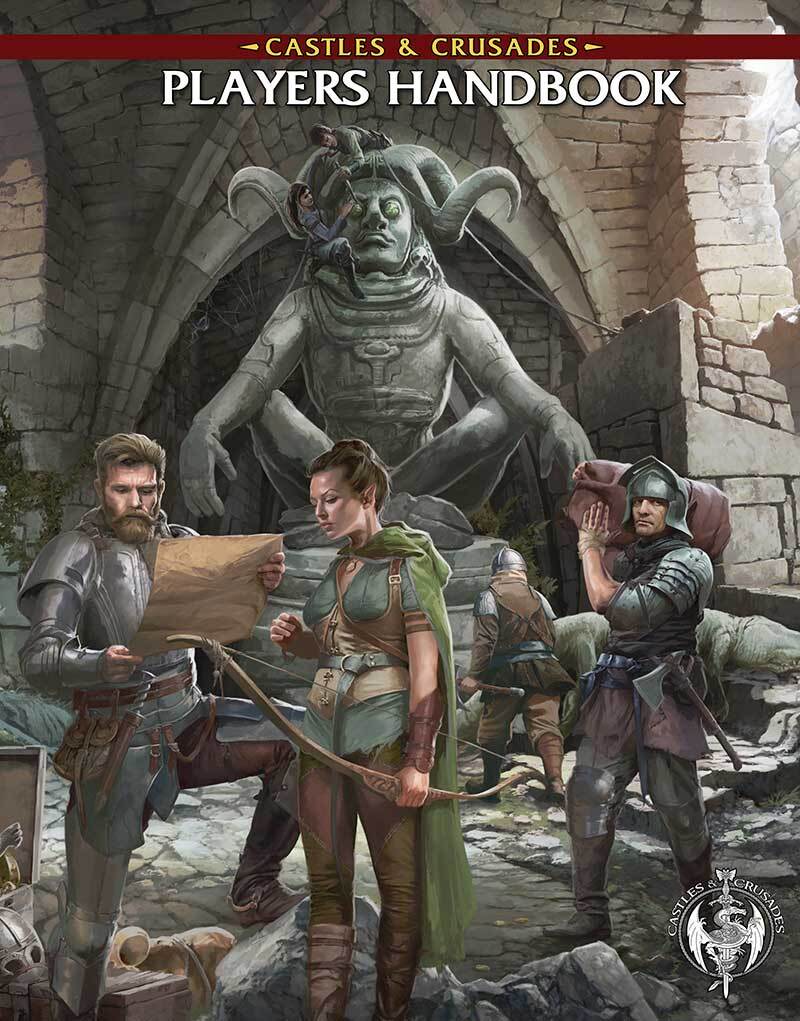
Castles & Crusades Added

This isn't in the gonzo genre, but it can be. I love this game so much that I put it away for a while to focus on other games; it just tends to "take over" every other fantasy game in my thinking and play.

It is that amazing.

I felt it wasn't "gonzo" enough, that deadly mix of tension and old-school difficulty that defines the genre. C&C has always been more of an AD&D 2nd Edition style "story game" to me that is compatible with the classics but feels more suited for stories like Dragonlance and the other classics of the 1980s and 1990s.

It is one of my "best of all time" games.

I felt that removing it would help me focus on this blog better. Well, I was wrong about that. I tend to do better with a more narrow focus, but in light of people trying to divide the old-school community, we should not reject any old-school game from any space.

C&C can be a "gonzo" game if you play it that way. It takes adopting that gonzo look and feel, but it can be done. I always felt this was one of the more "serious" retro-games, so it did not feel in this genre, at least not to me.

But let's give it as chance.

In light of the dumb comments many are making about Shadowdark and trying to split the old-school community, I am adding C&C coverage here. We can't be divided. It is funny, when big companies release updates to their games (and try to signing players up for live services), lots of trouble is stirred up in the old-school gaming sphere.

Many troublemakers are trying to stir up anger and division, but we should not let them drive us away from this fantastic place with amazing fans. The value of the old-school community is far greater than the drama they are trying to create.

All old-school games belong together.

I am sorry, I am unsubscribing from any YouTube channel that feeds into this division. I am also tired of the "D&D Beyond and Wizards" drama clickbait channels too; they are going on my unsub lists. I never used D&D Beyond, and I don't care. The last time I used an electronic character sheet was in D&D 4 days, and I learned back then that those online character services are only supported for longer than 5-10 years, and you will lose it all someday.

I still have 40-year-old index cards with characters that are still playable for dozens of games. They are yellowed, but "data retention" on a hand-made character sheet beats many media formats and cloud services.

I still need to find shelves to commit to C&C.

And I need to do a better job balancing all these amazing games.

It is a nice problem to have.