Monday, December 8, 2025

Second Edition was Player Empowerment

The moment we realized that the XP for GP system was thrown out for AD&D 2nd Edition, it changed the entire game for us. We became fans again. The "natural assumption" that experience means reward and story progression, rather than "cheating by finding a 50,000gp emerald" and rocketing up the level chart, made us reevaluate the game's core assumptions, and the system became fun again for us. Here is an example of why.

Let's use Old School Essentials Classic Fantasy for this one, and assume we are the referee laying out a sandbox world. Now, this is how I would never lay out a sandbox world, so this is just for our example. Let's say our party consisted of your typical fighter, mage, thief, and cleric foursome. We decide what the maximum level of the players will be in this sandbox, say, level seven, and then go to the XP charts. 

We see that 80,000 gold pieces per character are needed to get everyone to level 7, which is level 8 for the thief, but it is close enough. Multiply that by four, and then we have 320,000 gold pieces of loot we need to spread through the world to get them there, and we can assume they will miss a lot of loot so we can be a little on the generous side, or "place unfound loot" in their path if they miss out on the 10,000 gp they walked by in the last dungeon.

We get minimal XP for monsters, so it is better to steal the loot rather than kick down the door and fight. This encourages creative thinking, which is a benefit. Wandering monsters give us minimal XP, too, so the fewer we meet, the better off we are. Wilderness encounters are the same, just a waste of time.

We are living in a BX, BECMI, 0E, and 1E world here. Gold and loot are experience. Rob, cheat, lie, and steal your way to fame and glory. Avoid fights. If it isn't bolted down, take it and sell it; every gold piece helps. Rusty weapons? Take those too, if we have the weight allowance. Also, for the most part, ACKS follows this model too, though it has the advantage of needing all that money in the domain game.

And, as a referee, I would stop handing out treasure; progression would all but stop. I can stop a campaign's progression dead in its tracks with a GP equals XP game. I just get stingy with the loot.

The key takeaways here are that the referee has strict control over progression through loot distribution and that fights are best avoided. Wandering monsters and random encounters are terrible things.

Back to the Second Edition, and I refuse to play the POD reprints as I fully support the community games. I recently watched a YouTube video by a noted OSR creator who said there is "no need" for retro-clones these days, now that you can buy the originals from Wizards. He is 100% and utterly wrong for saying that, as retro-clones are needed to protect against "future shenanigans" by Wizards, and also, there is NO WAY you can legally publish an adventure and say "this is for AD&D" or anything other than the current, supported version of 5E these days.

The community relies on retro-clones to publish new material for these rule systems. Do I want to publish and sell an AD&D 1E adventure? Use OSRIC. BX? Use OSE. Second Edition? Use FG&G.

You can't go on the Dungeon Master's Guild and write AD&D and BX adventures. They must be for 5E only. Until Wizards releases the previous editions of the rules to Creative Commons, supporting retro-clones and holding them up as "the definitive edition we should be playing" is the best way to go. Also, the POD reprints have errors that have not been fixed.

I take it a step further and play the retro-clones, and choose to talk about and only support them. This is how we immunize the community from a future OGL Crisis, and this is the only sane position to take in these "corporate times" of greed. To just say "buy them from Wizards" does a massive disservice to the entire community of creators, third-party adventure and expansion creators, and the entire market as a whole.

I can publish an adventure for OSRIC and sell it.

I can't publish an AD&D adventure at all; there is no way.

I am not sorry for calling this out, nor pushing the clones over the originals. We got into the OGL Crisis because of this laziness, and it will happen again the day DM's Guild goes away. This is gaming: every service and site gets cancelled someday, and all your digital content is lost, so you will need to repurchase it somewhere else.

When that day happens, all the people playing the POD reprints will flood YouTube to complain and be milked for outrage clicks, and I will be over here happily still playing and creating for my retro clones. I will get so much time back in my day, never need to watch the hundreds of hours of anger, and be happy with what I have.

All because of making the right choice today.

While I may use AD&D 2E PDFs in my games, For Gold & Glory is my Second Edition core ruleset. OSRIC is my 1E, forever, even with the sacred words of Gygax in print. I do not care, and I am making the right choices. If enough people do this, it creates the change we want to see.

Do you want to create change?

Or do you want the world to continue down the path it is on?

Be the change you want to see.

Back to the subject. The XP we get for a hill giant in BX and OSE is about 650 XP for defeating them, divided among party members, so about 150 XP. When your next level is over 20,000 XP away, that is a drop in the bucket, and given this is BX, and we could be 15,000 XP away from the next level, this would mean defeating 100 of them (with no treasure), just to reach the next level. Monster XP is near-worthless in BX games. There is no way a party could even fight 100 hill giants, even one at a time, without taking losses, not to mention that it would take forever.

Hence, treasure is the XP equalizer.

How about First Edition? In OSRIC, we are better off with the hill giant at 1,800 XP. Now we are getting somewhere. With 450 XP per party member, we are still talking about needing 33 of them (minus treasure) to clear that 15,000 XP. That is still a steep hill to climb without finding treasure, so even in OSRIC, it is better to avoid fights and just grab the loot.

Second Edition and For Gold & Glory are the moments when everything changes, and they did for us. Even though they stripped out half-orcs, demons, and assassins from the game, this was still the best edition of AD&D we ever played, and it got us in the game for a full 10 years. We skipped 2.5E and just used the core rules, which are beautifully preserved by FG&G. We could still back-port in the missing elements from 1E, and when Planescape 2E came about, the demons were back under new names and management.

What about the Second Edition?

No XP for treasure. None. It is an option in the DMG, but discouraged, and it is not mentioned in FG&G. You do get "Story XP," which should be equal to the XP gained for overcoming encounters while accomplishing that goal, and the degree of challenge. The language is essential here! Overcoming encounters also means surrender, fooling them, helping them, turning them into allies, or any other way an "encounter" can be "overcome."

So the hill giant in FG&G is worth 6,000 XP, nearly ten times the BX experience amount. Double that if you defeated the hill giant in a quest where the beast was attacking a village, and you were helping people or doing something heroic. If you convinced the hill giant the town wasn't so bad, and got the townspeople to back off, and they all lived happily ever after? Guess what? You still got the full 12,000 XP, split among you.

The encounter was overcome. The story goal was completed with a positive outcome.

And you didn't need to grab a single gold piece to earn those XP. You never needed to worry about treasure, and its importance was secondary. Mind you, it was still nice to have, but having the game's focus shift from acquiring gold and wealth to heroism, accomplishing quests, and story goals was huge for us. This, even though the rules were 99% the same as First Edition, was enough to make us fans of the game again.

And let's factor in random encounters now. Overcoming random encounters on the path of completing a story goal means the XP value of those encounters, already very high, is added to the story XP for the quest. So that pack of hyenas you fought on your way to the hill giant cave as a random wilderness encounter? It counts toward completing the story, and the already high XP is doubled when the story is finished. Are the cave beetles encountered as wandering monsters in the cave? They all count.

Zero gold pieces were gained here.

Note, in FG&G, magic items do give XP. This is the only exception to the XP for treasure rule, but the XP values are about on par with defeating a monster, so it is a minor adjustment, and certainly nothing you can depend upon for leveling. Still, that XP does count towards "story XP" when they are calculated.

As a referee, I do not need to place 320,000 gold pieces around my sandbox to account for leveling anymore, nor do I even control progression all that much. Most of that is in the player's hands, with the monsters they defeat and the stories they undertake, which could also be their own stories and goals.

This is another essential thing. Story XP is not just "referee quests" but can be a part of a character's personal storyline, goals, and motivations. If a character starts a self-initiated "revenge arc," it could create Story XP for the various milestones and story points along the way. Never in the First Edition did they do this, yet it is possible in the Second Edition.

If players just wanted to "wander the map" and "kill everything," well, then that playstyle opens up, too. It is a bit pointless, but it is an option. Story XP will double progression speed, but they are free to wander the map like Grand Theft Auto and cause chaos if they want.

FG&G and the Second Edition rules do have the problem of "not needing money" at the higher levels. There are no prices on magic items here, nor were there in Second Edition AD&D, which openly dismissed the idea of "magic item shops" in the DMG. Is gold not being important really a problem in Second Edition? The entire concept of wealth as advancement was removed from the game, and characters had minimal need for wealth beyond hirelings and gear.

You have to remember: Second Edition was positioned as "the game for the novels," and the novels weren't about gathering all the gold to get progression either. In the novels, the characters performed heroic deeds, learned, and grew stronger, but never really reflected the original game's "gold for XP" concept. So Second Edition simulated the NYT Bestseller novels of the 1990s pretty well, and that is what the game was built for.

If there is no dominion game, and you don't need to buy magic items worth hundreds of thousands of gold, what do you need gold for? Gold is only required to buy a few things: travel, hirelings, mounts, and pay for lodging and supplies. You could run a "low wealth" game in Second Edition and never affect progression, player power, magic item availability, or any other part of the rules.

That is a feature, not a drawback, since chests full of gold tend to weigh down a party and limit their ability to travel and adventure. In a more story-focused game like Second Edition, if we need to get to "Danger Falls" to save the princess, we hop on our horses and head out. Who cares about securing 30,000 gold pieces of treasure in a bank or stronghold? Let's just focus on the story and go!

For groups wanting a more story-based game that focuses on heroics and not wealth, the Second Edition was built for that exact purpose. This may be the game you were looking for but never knew you wanted.

There is no way for me to stop progression in a Second Edition game as a referee, nor should there be. The game goes from referee-controlled to player-driven, with a much stronger focus on story arcs, quests, plots, and goals. The world and the NPCs become much more critical, along with factions and their motivations. If Orc barbarians are burning the northern villages and sacking towns, there is some instant motivation for players, and no treasure needs to be dangled in front of their faces for the players to want to jump in.

All the players need are goals and stories to go out and be heroes.

These will be driven by the NPCs, factions, and centers of civilization in the world. This is how the referee controls interest and drives player agency.

The rewards will be in the stories the characters tell. Not in the loot locked up in dungeon rooms.

And your characters are free to go wherever adventure calls them to.

Originally published on the SBRPG blog, 11/25/2025.

Second Edition Bliss

BX, BECMI, 0e, and White Box tend to be too simple for me. I see most of YouTube going crazy for this easier-to-play system, and yes, they play fast and don't require much rule support, but a lot feels missing. What will always be true is that the BX system as a "base compatibility layer" is the bedrock of gaming, a standard set of math and numbers that all games can communicate with and use.

The one thing Wizards did to "own the game" was break backwards compatibility, which was a sin, and it destroyed D&D. We have the scaling damage of 3.5E, the insane triple-down hit points of 4E, and the doubled hit points of 5E.

There is nothing wrong with the original math. THAC0 is laughably easy; don't listen to the clowns out there. Roll a d20, add the target's AC to the roll, did you roll THAC0 or higher? You hit.

Of course, you are using descending AC too here, but there is nothing wrong with that either. The better the armor, the less of a to-hit bonus you give your opponents. It is simple. Do you have AC 0? The entire world gets no bonus to hit you.

In fact, you can pre-adjust THAC0 for your melee and missile attack adjustments, and it gets even easier. My 6th-level fighter with a THAC0 of 15 has a +1 melee-hit bonus from STR, and a +2 sword. My base THAC0 is now 15 - 1 - 2 = 12. Have fun adding that proficiency bonus, ability score bonus, and weapon modifier to every attack, 5E players. Even if you make it one number, you are still adding it to every roll in 5E and comparing it to a floating target number.

5E is more math versus a floating target number (AC or DC).

With THAC0, my target number never changes: I only add a number from 10 down to 0 (or lower in rare cases) to my attack, then check my THAC0. I attack an AC 3 creature with my THAC0 of 12. Roll a d20 + 3, beat THAC0.

Also, with the second edition, you lose the demons and devils in the game. OSE does not have them either, and that has not stopped that game. They are the same as in the first edition, so port them in from that, and adjust the XP awards to the second edition standards. Or, use the renamed ones out of the AD&D 2E Monster Compendium and Outer Planes Appendix. They are all there; you just have to do a little finding.

Personally, our Forgotten Realms game ran fine without them for a decade, and I liked having to be creative with other monsters and not fall back on the same old tired enemies. Let the mastermind be a red dragon this time, or an intelligent purple worm. Use an NPC. With Tieflings everywhere in 5E, I am tired of modern D&D proving the Satanic Panic right, and they have become as exhausted as the Drizzt trope. Sorry to burst your ideal character bubble, but everyone is playing them, and they are tired now.

Plus, if you remove them from the "normal world" when demons do show up, it feels special again, and not everyone is playing one. Let evil be evil, and stop co-opting it.

I like For Gold & Glory, the beautiful, free second-edition retro-clone. The book is far better organized than the Wizards reprints, and the core-book art is superior. I will give the 2E Monster Compendium scores on better art for plates of each monster, even if they are slightly cartoony. FG&G does the job, feels like classic AD&D, and the PDF is free for everyone.

Why am I buying BX OSR games when I have this? Designer hubris? To say I "have something" and try to use that as an influencer? Why is it that on YouTube, most OSR influencers are trying to sell you something while ignoring the free games? Why is it Labyrinth Lord versus Dragonslayer all of a sudden? Are we all dumping OSE, which is also an expensive version of the game, for some reason?

The ads were bad enough on there; now all the videos are ads.

OSRIC is free. FG&G is free. Even Basic Fantasy is free.

Are we in this for the game and community, or are we here to sell people things?

Another great thing is FG&G's compatibility with the 2E complete guides, which give us "subclass options," or what we call character kits, to flavor our character classes without creating new ones or piling on complexity. A gladiator or barbarian is a fighter with a character kit; it is simple and easy, reducing rules bloat. These books you need to buy from Wizards, but they are worthy and an improvement over the first edition.

I love character kits over 5E's mess of subclasses. This is a much cleaner design, and it works perfectly. I never want to see hundreds of character classes and subclass options for each one in a game ever again; it is a terrible mess of a game design that reminds me of tangled, knotted, dusty, and filthy cords behind an entertainment center. 5E's design sucks, and it is far too complicated for its own good.

A gladiator, cavalier, or barbarian is a fighter with a character kit. No new classes are needed. The design achieves flavor with minimal rules interaction, and is a modern, object-oriented design that is clean and simple. There is a beauty to 2E's design that has never been replicated, and certainly not by the BX-obsessed OSR. Many OSR games will create a gladiator and barbarian class, just to fill books and sell you more stuff.

Yes, I am calling this out, but the OSR suffers from many of the problems that ail the 5E design community. Where simplicity, inheritance, and elegance can solve a problem, many OSR games do the same exact thing that 5E does: create classes to please the collectors, sell books, and bloat the game until it becomes unplayable.

Character kits rock.

THAC0 is the better system.

The second edition wins on solid design principles.

The AD&D 2E monster book is also a purchase if you want the product identity monsters; for FG&G comes with plenty of monsters of its own and is compatible with all of OSRIC's monsters, too. For that matter, all of BX is compatible too, just make sure descending AC is supported, as it should be. If you look around, you will find literally tons of OSRIC and Swords & Wizardry monsters that are directly compatible with second edition, and there is no shortage of foes to fight.

We have bards here, too, so that is not a reason to skip out. In fact, bards are a more challenging class to play, and I like that design since it forces you to have a high degree of player skill and leverage your roleplaying chops, which you should be doing as a bard instead of falling back on designer gimmes and free magic powers. I would not let an inexperienced player choose a bard in 2E; this is for skilled players only. As it should be.

Add the second edition's story XP and increased monster XP on top of what is already the best version of the game, and you have pure gaming bliss.

Originally published on the SBRPG blog, 12/6/25.

Wednesday, December 3, 2025

D&D 6E? AD&D Re-release?

The latest thing on D&D YouTube is rumors of an AD&D re-release by Wizards.

I would like to see this, as long as it is unaltered, with no modern art, and it is not censored or changed.

But I know better. I don't trust Wizards all that much.

And we have better options in OSRIC, OSE, Dragonslayer, and Dungeon Crawl Classics. But here is my feeling. A game is not just the rules.

A game is the support it gets. Dungeon Crawl Classics and over 100 adventures? That is far, far better than an AD&D re-release, and offers me more fun and long-term gaming than simply printing a new edition of nostalgia and calling it a day.

The writing team at Wizards does not have it in them to release anything as significant as the Tomb of Horrors, Ravenloft, or any of the classics. They do not have the writing chops or old-school sensibilities to write anything other than modern tripe.

An AD&D re-release?

One and done.

Likely smeared with current-day politics to rub agendas in our faces and tell the grognards they are - and will always be - horrible people. Just like they did to Gygax. Will the book come with a warning message?

They still have a long way to go to regain good graces. If they open the license to 1E as a result? Then, that is an excellent start on the way back. You have my interest. I am bought in. That ensures the community can step up and support the game. It is a great move to mend fences. I will support that.

PDFs not tied to D&D Beyond? Now we are talking. I don't mind if they support this on D&D Beyond, and I encourage them to take that step. All should be able to play whatever version they love and remember. Wizards need to get out of the rules-writing business and into the "playing D&D" business. They already have too many versions of the game to support. A 6E will make things worse and further divide the fans.

They should support OSRIC, OSE, Basic Fantasy, C&C, Labyrinth Lord, DCC, Dragonslayer, and any other D&D version on D&D Beyond. Bring everyone in the tent. Sell all their digital books, with options for physical copies. PDFs to own, please. Support everyone's character creation methods. Everyone comes here to play. Why not?

Be more like Facebook, and less of a "book publisher."

But OSRIC and other community-supported BX games will be here to stay. This is the measuring stick of their progress.

And DCC has the support to keep me playing long after the Kickstarter ends and interest wanes.

Thursday, October 30, 2025

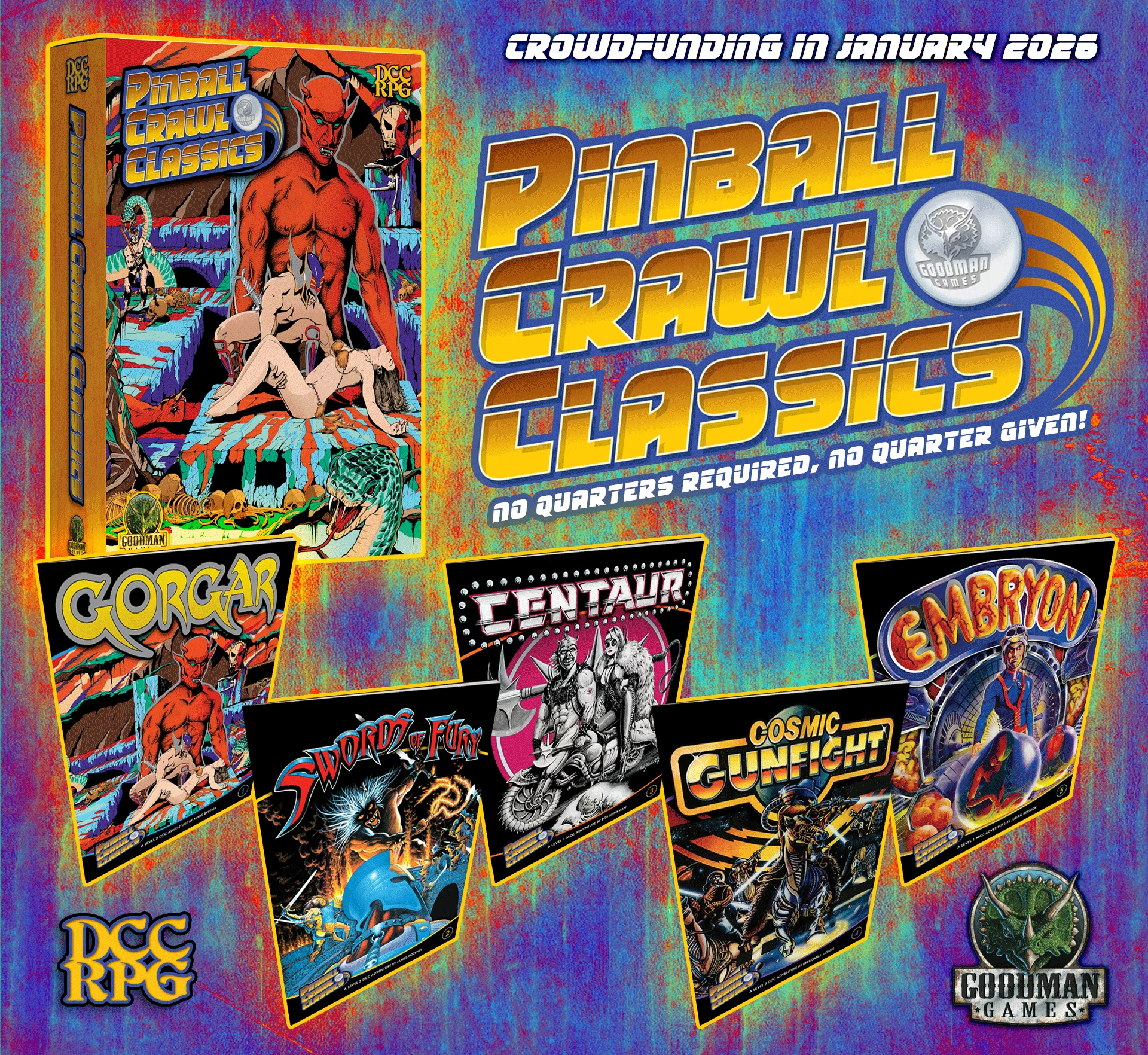
Dungeon Crawl Classics: Pinball Crawl Classics

https://www.backerkit.com/call_to_action/891f2362-d05c-43a2-857f-417bb038207d/landing

I really like the idea of Pinball Crawl Classics, a series of DCC and MCC adventures based on classic pinball machine art and the imagined stories behind those games.

For a while, I felt DCC was leaning too hard into adventure remakes, and the game had felt stale. I love the deluxe treatment of classic adventures, but one can only have so many megadungeons before they start to feel a bit overdone. They are all fantastic and incredibly crafted, but I longed for something different and new.

I felt myself drifting back towards BX, BXA, and 1E.

DCC is always fun, but the classics call to me like a siren's song.

https://www.amazon.com/Art-Atari-Tim-Lapetino-ebook/dp/B01I1YU47U

Adventures around the art of pinball games? What a silly and cool idea. This reminds me of the box art from classic Atari games, where each one told a story you brought to life in your head as you played. There is a jump in that time where "you made the story in your head" that captures the essence of the era perfectly, and we did the same with pen-and-paper games.

Yes, the games were just collections of blocky pixels, but our minds did the rest.

Yes, D&D was just six 3-18 stats, a class, level, and some hit points, but our minds did the rest.

We never needed the "3d VTTs" of today, the pages-long character sheets, the character builds as complicated as a tax form, and all the layers of depth and detail that end up robbing your imagination of its ability to craft stories in your head.

Wizards' D&D is designed to strip the game of all imagination and turn it into an online character sheet. Pathfinder 2's character sheet is filled with hundreds of boxes for mostly pointless modifiers. There is a myth about a camera taking a piece of your soul when you have a picture taken. With modern games, you lose a part of your imagination when you have to fill out a soulless, complicated, mechanical character sheet, and we dream of "builds" and "power gaming" rather than story and make-believe.

This one project has reignited the love I thought was fading from the game and tells me the team there "gets it" when it comes to the magic and make-believe of the old-school games. Goodman Games understands the myth and magic of old-school games far better than many of today's soulless recreations that get the rules right but the inspiration eludes them.

The game we loved is more than a word-for-word recreation of the rules.

It is the era and the myth of the time, with the digital mind trap of technology stripped away, and imaginations free to create worlds in our awakened dreams.

They get it.

Thursday, September 18, 2025

Mail Room: Comes Chaos

Comes Chaos is a fun book. This campaign adopts a "corruption of the land" style, similar to Warhammer FRP, but with a B/X-style spin on its entire structure. This is not "WHFRP in D&D" but more of its own thing, presenting a system of chaos mutations, monsters, magic, and hexcrawl mechanics for any B/X-style game.

The game also features a corruption system that can impact player characters, induce chaos mutations, and draw them into madness and darkness. The game also features four "chaos entities" that function similarly to Dungeon Crawl Classics patrons, and an optional section of the book enables the creation of evil campaigns. The "evil campaign" in this book could end terribly, and result in your "chaos champion" displeasing their chaos lord, gaining too many mutations, and being turned into a giant flesh-blob monster, and being lost to the game forever as a creature NPC.

There are chaos spells and magic items for use as character, NPC, or villain items. There is a bestiary too, and different chaos lords dislike others, so there is a fair amount of inter-chaos battling and backstabbing. The book can be inserted into any campaign world, a random hexcrawl world, or used to seed a new campaign.

The book also details how the corrupted chaos lands spread, and how bastions of civilization ward against the land's corruption - until the city falls to corruption, which means lots of roleplay, intrigue, and hunting chaos cults in cities to fend off the decline and decay of civilization.

This book, plus Old School Essentials, gives DCC a run for its money. Not in the "fun factor" of DCC and all the crazy dice, along with the super-heroic characters, but in a campaign simulating how corruption crawls across a game world and slowly destroys it from within. Anyone can be corrupted, and even entire cities and kingdoms can fall. While DCC has "magic is corruption" on a personal scale, it fails to extend that to the larger campaign setting and cause permanent change in the world.

This book gives me that missing piece.

Wednesday, September 3, 2025

White Star Galaxy Edition

White Star Galaxy Edition (WS-GE) is a fun, white box, OSR science fiction game. It follows the White Box design theory, where we only use the d20 and a d6 dice, and all the others are ignored. No d4 dice to step on, no d8, no d10, and no d12. This is all White Box compatible, so any fantasy implementation of the rules is an instant expansion set.

And we don't need all those funny dice! I love them, but there is something very clean and simple about a game that just uses the d20 and the d6, a feeling of streamlined elegance and simplicity. What die do I roll? Well, you have two choices. One it used for to-hits and saves, and the other one is used for everything else. Considering the average rolls of the 4d, d8, d10, and d12 are mostly a few points off the d6, a flat modifier takes care of all the variance you would ever need.

Also note, in true White Box games there is no d10 or d100, so those huge d100 charts are out of the question. If you need a lot of chart results, use a d20 and be choosy about your table entries, or just for a d66 for 36 results and that should be plenty. A d40, d60, d120, or d400 is also possible if you get creative with two dice.

You could mix this with White Box FMAG and double your monster list, and have a bunch of fun "low tech world" stuff to expand your game with. The magic works, too. It all works. Unlike today's games where they purposefully make the rules incompatible with everything else, White Box just works, and it works with every other White Box game.

And the game has this space adventure feeling, sort of a mix of Star Wars, Spaceballs, Star Crash, Battle Beyond the Stars, Guardians of the Galaxy, the Buck Rogers TV show, and any low-budget 1980s science fiction you would find on random cable channels.

And this is "class and level" science fiction, where you are gaining hit points and blasting higher level monsters as your adventures go up the level chart. This is like "straightforward Starfinder" without the 3.5E or PF2 rules, and it just works well and plays fast. And there is no magic! We have psionic power like gifts here. If you want space magic, pull it in from the fantasy game. It just works.

And both WS-GE and WB FMAG use the single saving throw mechanic, eliminating those strange saving throw charts for a single saving throw number (modified by internal or external circumstances).

And there are plenty of expansion books to collect for this game, with tons of options. This is 0e science fiction role playing at its best, completely compatible, it doesn't take itself too seriously, and it has fun with the idea. The game has good "star knights" and evil "void knights" who wield "star swords." It is a campy take on some of the science fiction tropes, but, I kind of like that in a "this is generic science fiction way" and I could come to accept the idea as something cool.

If it keeps creators writing these types of stories and out of hot water with IP holders, than the generic replacement is far superior to the original inspiration. Plus, we are free to take these ideas in our own directions and tell our stories with them, and not just "do what the rights holders allows us to do." Maybe the old "IP names" were "lost to the past" and these are the new and accepted names for the protectors of the galaxy. In the future, 600 years later, they are star knights now, and the old words are looked down upon or lost to time.

It is cool.

Make the universe your own. 

Monday, August 4, 2025

Run Your Character Sheets by Hand

The worst part about 5E is needing a computer to manage a character sheet. I love running sheets by hand, and filling them out the way we used to do. When D&D 4E came along and introduced the "website to track characters" - we loved it at first. And then it got to be a dependency. And then it became a pain point. And then the system was shut down and everything lost forever.

And 5E started off innocently enough where you could hand-run character sheets, and then book after book piled on the system, and you needed an online system to manage the complexity. Even the Open 5E clones all require online character sheets. After a while, 5E stops being a pen-and-paper game, and it slowly morphs into a computer game with "software as service" features and micro-transactions.

5E is a computer game pretending to be a role-playing game.

It is a wolf-in-sheep-clothing gateway to making you pay for that "something else" you need to make your life easier. This is the worst part about the system. This makes the entire game hard for me to justify and support. It does get expensive to play this.

Any OSR game is far easier to play and manage. In any version of the game past AD&D 2nd Edition, your character gets weaker as they level. You lose power, and your character is never as strong as they were in the older games. People saying, "I need 5E since it gives me the most options when leveling" are being lied to. You get weaker as you level! You don't even retain power. Your fireballs do nothing due to scaling monster hit points. I proved it here with math:

https://sbrpg20.blogspot.com/2025/07/no-to-d-4e-yes-to-old-school-essentials.html 

You are far better off sticking with AD&D or a B/X system than you are playing D&D 3, 4, or 5. Even for martial characters with fixed damages, melee damage scales better in the older games. you don't need that feat that makes you do "+10 melee damage" feat if the monster hit points are on a linear scale and not a ramped up exponential curve. You see that hack added into the game to "fix things" for martial characters and you should get suspicious of a broken design immediately.

We had everything back then and Wall Street came along and "fixed it all for us." See, it feels good, like a AAA video game. Please pay our monthly fee for updates.

So, for a system that makes me weaker as I level, now I need to pay tons of money in subscription services to manage character sheets and buy expensive digital books (that I will never own and someday go away) for more weak options? And in the older systems where I am more powerful, I can still run character sheets by hand and not pay anyone anything?

You are kidding me, right?

I guess it is a good business to be in if you are a publisher or software as service person.

But not for me.